Oct 28, 2013

Punctuating Manuscripts


Have you ever considered what a text would look like without punctuation? In what way would an author ensure that they successfully conveyed the appropriate meaning to their audience and how would the audience identify meaningful units, or senses, within a text? Punctuation is, and always has been, a useful way of dividing text into smaller units of meaning, dispelling ambiguity and developing a specific meaning. In approaching text as a model of information it is important to consider not only how information was encoded but also how it was decoded – a process in which punctuation has been, and continues to be, a powerful tool.

Oct 21, 2013

Word by Word


Franks Casket, front panel. Image: British Museum.

Corpus Glossary, CCCC MS 144, fol. 58v (detail)

Vespasian Psalter, British Library MS Cotton Vespasian A.1, fol. 24r (detail). Image: British Library.

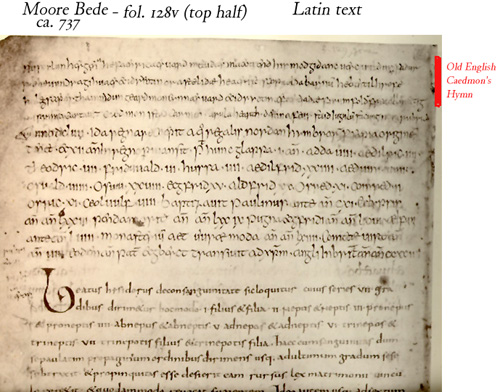
Cambridge University Library MS Kk. 5.16, fol. 128v (detail)

These four documents all include English text in some form, and all date from the eighth century. The first, the front panel of the Franks Casket, features an Old English riddle in runes. The second, the Corpus Glossary, provides meanings of Latin terms in Latin and sometimes in Old English. The third, the Vespasian Psalter, gives an interlinear Old English gloss on the Latin text of the Psalms. And the fourth, a copy of Bede’s Historia ecclesiastica, includes the Old English text of Cædmon’s Hymn as an annotation to the Latin text. All these documents provide graphic evidence of the way early English writers thought of their language as being divisible into word units.

Oct 4, 2013

Lost in Information


Where is the wisdom we have lost in knowledge?
Where is the knowledge we have lost in information?
    - T. S. Eliot, Chorus I from The Rock

. . . literacy is still the only bulwark against the dissolution of language into ‘information systems.’
    - Ivan Illich and Barry Sanders, Preface to ABC: The Alphabetization of the Popular Mind

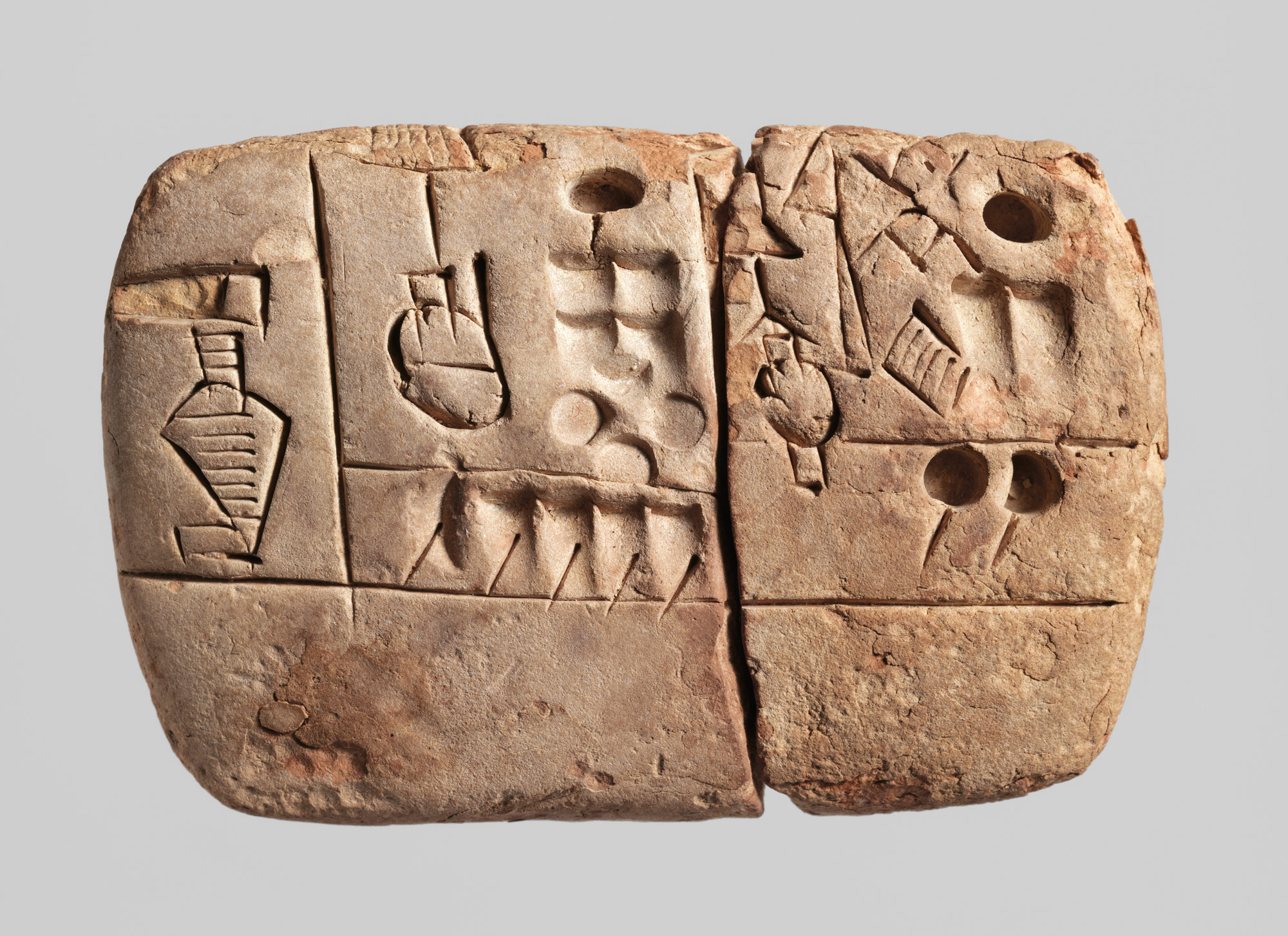
The technology that emerged to meet those needs – writing – filled a prosaic but essential purpose: accounting. The impetus behind its invention was not a desire to faithfully record language, but to record trade transactions, crop yields, and taxes – to record and preserve information, not language.
    - Amalia E. Gnanadesikan, The Writing Revolution: Cuneiform to the Internet

Sep 18, 2013

Starting in the margins

Monument to Cædmon, Whitby. Image (cc) Rick Harrison
This impressive modern stone cross in Whitby, England, commemorates the creation of the earliest recorded poem in English, now usually called ‘Cædmon’s Hymn’. I won’t go into the story in detail here (although it’s fascinating in itself), but I do want to emphasise that Cædmon was not, as is sometimes claimed, the first English poet, nor was his ‘Hymn’ the first English poem. The very story of Cædmon, as told by Bede in the 8th century (at least half a century after the event), indicates that poetic composition in English was well established, but also that it was wholly oral; and that Cædmon himself, a layman employed by the monastery at Whitby to take care of the cows, was illiterate and had to have Bible stories read or paraphrased to him before he could turn them into English poetry. Cædmon’s Hymn, a fragment of what was presumably a more extensive poetic corpus, was preserved not because it was the beginning of English poetry, but as a marginal note to the Latin text of Bede’s Historia ecclesiastica gentis anglorum.

Sep 7, 2013

Translations

The Journey, by Fenwick Lawson. Image (cc) Kaihsu Tai.
More on St Cuthbert: in recent news, it has been reported that a sculpture (called The Journey, by Fenwick Lawson) of monks carrying the coffin of St Cuthbert of Lindisfarne may be relocated from Millennium Place in Durham to a spot outside Durham Cathedral. A BBC news article quotes the trustees of the sculpture as saying that not enough people see the piece of art in its current location, but the Sunderland Echo provides a less dignified reason, the fear that the statue might become a target for drunks. In any case, the move is oddly appropriate, since the statue commemorates the move of the actual body of Cuthbert from Lindisfarne, where he died and was buried, to Durham. The monastic community at Lindisfarne, where Cuthbert was bishop until his death in 687, repeatedly raided and threatened by Vikings from 793 onwards, relocated inland: first to Chester-le-Street (near Durham), then to Ripon, then finally to Durham in 995. The monks took with them the coffin in which Cuthbert’s body and his relics were preserved.
"In the multilingual world of medieval England, translation was a ubiquitous and important form of information transfer."

One common meaning of Middle English translate (and medieval Latin translatare) was ‘to move something (for example, the body of a saint) from one place to another’. But already, by the 1300s, the word was being used metaphorically to refer to the transfer of information from one language to another: the Northern Middle English poem Cursor Mundi (c 1300) explains (lines 232-236) that

    þis ilk bok [is] translate
    In to Inglis tong to rede
    For the loue of Inglis lede,
    Inglis lede of Ingland,
    For the commun at understand.

‘This very book is translated into the English language for reading, for the love of English people, English people from England, for the common people to understand.’

In the multilingual world of medieval England, translation was a ubiquitous and important form of information transfer. But the meaning of ‘translation’ was broader in the Middle Ages than it is now; linguistic translation, like the translation of a saint, was a transfer of what was meaningful or valuable, not necessarily a correspondence of the textual elements in one language with the textual elements in another. An extraordinarily high number of medieval English texts are acts of translation. At one end of our time period, the earliest surviving extensive English texts are Latin-English glosses; at the other end, in the fifteenth century, many of the earliest books printed in England were William Caxton’s translations of French texts – a cloth merchant’s importation of fashionable literary goods from the Continent.

Yin Liu

References

On the broader meaning of medieval translation, see

J. D. Burnley, ‘Late Medieval Translation: Types and Reflections,’ The Medieval Translator: The Theory and Practice of Translation in the Middle Ages (Cambridge: D. S. Brewer, 1989) 37-53.

Bruce R. O’Brien, Reversing Babel: Translation among the English during an Age of Conquests, c. 800 to c. 1200 (Newark: U of Delaware P, 2011), especially 45-51.

Thanks to Lisa Vargo for the tip about the proposed translation of The Journey.