Showing posts with label glosses. Show all posts

May 12, 2017

Latin Glosses and Commentaries: The Prick of Conscience

Tristan Taylor

The Prick of Conscience is an early thirteenth-century didactic devotional poem and is one of the most circulated English verse texts with over 178 witnesses (manuscript copies of the poem). The poem itself follows the cura pastoralia tradition of producing edifying texts for a lay Christian audience: it is a religious text which could be easily accessible to an audience that was unable to read Latin, the language that most religious literature of the time was written in.

Wellesley College MS 8, p. 61. This gloss announces to the reader that a list is beginning.
One witness of the poem is contained in Wellesley College MS 8. This late fifteenth-century copy contains an unexpected feature, however. While most of the text is in English, the manuscript also contains glosses. These glosses, unlike the main text, are composed in Latin. This poses an interesting question: why are the glosses in Latin if the main text is in English?

Nov 21, 2016

What is a Gloss? Part 1

Here's the first of a series of posts from Medieval Codes researcher Tristan Taylor:

Bibliothèque nationale de France, MS Latin 7980, detail of fol. 5v.

What is a gloss? The term appears with relative ubiquity in scholarship but there is little consensus on what constitutes a gloss. Is a gloss simply a string of text that appears beyond the borders of what modern readers consider the primary text? The primary concern when defining such a term is the beginning. But where do we begin? Can we simply examine historical usage as the foundation, or should we look at the etymological roots of the term? Alternatively we can examine how scholars have labelled glosses functionally; that is, can we categorize glosses based on what value they add to a text? Another avenue of exploration still is the spatial dimensions of glosses: where do they appear on the page? To define such a ubiquitous term, we more likely need to examine all of these dimensions and explore their relations to each other.

Nov 7, 2014

Who Glossed the Canterbury Tales?

Portrait of the Wife of Bath from the Ellesmere MS
In the last post, we discussed how the Latin annotations present in the Wife of Bath’s Prologue in various manuscripts of Chaucer’s Canterbury Tales allowed readers the potential for multiple different readings. Many scholars have suggested that Chaucer himself may have been responsible for adding the glosses, and thus also providing these layers of meaning. If this is true, the depiction of the Wife of Bath that most undergraduate students encounter may be very different from the one Chaucer had intended. Chaucer may have viewed the Wife of Bath as more than a bold and independent woman who, perhaps rightfully, refuses to be subservient to her husband. He may instead have intended to create a less flattering picture of the Wife of Bath. Thus, for those seeking authorial intention in the Canterbury Tales, the question of “who wrote the Latin glosses” can become quite important.

Oct 27, 2014

Latin Glosses to Chaucer's Tales

San Marino, Huntington Library MS EL 26 C 9 (Ellesmere Chaucer), fol. 63v

Most people interested in a medieval work will turn to a modern edition in order to read a text. Modern typefaces are easier for most modern folks to read than medieval scripts. Explanations provided by editors of these editions can prove invaluable for attempting to understand parts of the work that use archaic vocabulary or refer to practices or events no longer typically in use. Unfortunately, many of these editions relegate marginal annotations found in the manuscript to footnotes, endnotes, or appendixes – if they are included at all.

May 22, 2014

The significance of the page

The layouts of a medieval manuscript’s individual pages expose valuable information about the manuscript, and therefore about texts. Some scholars are working ‘to reconstitute the page of the scribal manuscript as an authentic object in its own right. . . . [I]t is not a mere transparency through which the author’s “original” is to be viewed but rather an artifact of independent visual interest’ (Butterfield 49). Such scholars are trying to vouch for the worth of everything on any given manuscript page, because all added notes beyond the original text also reveal important information: ‘Every decision of layout—[including added glosses]—not only reflects the assumptions and cultural habits of medieval readers but also forms assumptions and habits that govern the way in which the text is received’ (Butterfield 49-50).

British Library MS Cotton Vespasian A.i, fol. 13r, detail (opening of Psalm 3)

Feb 20, 2014

Latin in the margins

In a previous post, ‘Starting in the margins’, I noted that early examples of English writing were typically not standalone texts; rather, they tended to be glosses to Latin texts. In such bilingual documents from early medieval England, the Latin text was given prominence visually – the script was larger and it filled the main text block – while the English gloss, squeezed in between the lines in a smaller script or placed in the margins, was clearly meant to be apparatus in a supporting role.

British Library MS Cotton Nero D.iv (Lindisfarne Gospels), fol. 45r.


Although this relationship of Latin and English continued to be expressed in similar ways in documents throughout the Middle Ages, there are also many cases in which the two languages appear to switch positions: English as the main text, Latin in the margins.

Cambridge, Corpus Christi College MS 12, fol. 10r (detail)

Oct 21, 2013

Word by Word


Franks Casket, front panel. Image: British Museum.

Corpus Glossary, CCCC MS 144, fol. 58v (detail)

Vespasian Psalter, British Library MS Cotton Vespasian A.1, fol. 24r (detail). Image: British Library.

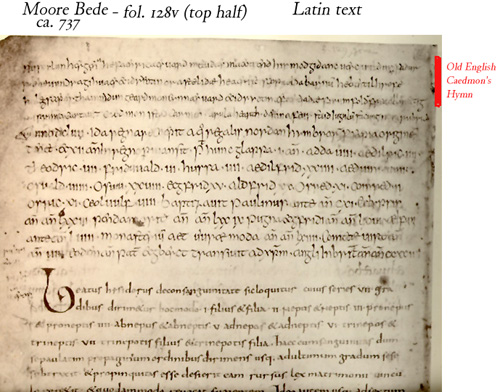
Cambridge University Library MS Kk. 5.16, fol. 128v (detail)

These four documents all include English text in some form, and all date from the eighth century. The first, the front panel of the Franks Casket, features an Old English riddle in runes. The second, the Corpus Glossary, provides meanings of Latin terms in Latin and sometimes in Old English. The third, the Vespasian Psalter, gives an interlinear Old English gloss on the Latin text of the Psalms. And the fourth, a copy of Bede’s Historia ecclesiastica, includes the Old English text of Cædmon’s Hymn as an annotation to the Latin text. All these documents provide graphic evidence of the way early English writers thought of their language as being divisible into word units.

Sep 18, 2013

Starting in the margins

Monument to Cædmon, Whitby. Image (cc) Rick Harrison
This impressive modern stone cross in Whitby, England, commemorates the creation of the earliest recorded poem in English, now usually called ‘Cædmon’s Hymn’. I won’t go into the story in detail here (although it’s fascinating in itself), but I do want to emphasise that Cædmon was not, as is sometimes claimed, the first English poet, nor was his ‘Hymn’ the first English poem. The very story of Cædmon, as told by Bede in the 8th century (at least half a century after the event), indicates that poetic composition in English was well established, but also that it was wholly oral; and that Cædmon himself, a layman employed by the monastery at Whitby to take care of the cows, was illiterate and had to have Bible stories read or paraphrased to him before he could turn them into English poetry. Cædmon’s Hymn, a fragment of what was presumably a more extensive poetic corpus, was preserved not because it was the beginning of English poetry, but as a marginal note to the Latin text of Bede’s Historia ecclesiastica gentis anglorum.

Jul 25, 2013

Reading in two languages

Yin Liu 

The oldest surviving English translation of any part of the Bible can be found in this manuscript:


The translation consists of the smaller words written above the larger main text. It is not a Bible translation in the sense that we customarily think of – that is, a text that can be read in its own right. Rather, this translation takes the form of an interlinear gloss, intended to help an English speaker read the Latin text.

The image is from a page of the Vespasian Psalter, British Library MS Cotton Vespasian A.1, a copy of the Psalms in Latin. The manuscript was made in the second quarter of the 8th century, probably in Canterbury. The gloss was added just over a century later, in the middle of the 9th century. The image shows the start of the psalm Caeli enarrant, Psalm 18 (Psalm 19 in most modern translations). The script of the main text, in Latin, is in English uncials; the gloss is in an insular pointed minuscule, in a Mercian dialect of Old English. The English gloss provides a word-for-word translation of the Latin: thus in omnem terram is glossed in alle eorðan (‘into all the earth’). This way of presenting a text in two languages probably seems straightforward and self-evident to us now. Think how often students annotate their textbooks in just the same way when learning a new language or reading a text in a language in which they are not fluent; and in modern linguistics, interlinear glosses, laid out in much the same way, are a regular feature to assist readers in understanding examples of speech or text in many different languages.
This bit of parchment shows an example of medieval text being encoded, structured, and presented as data

Nevertheless, that bilingual interlinear glosses are among our earliest surviving examples of English text (and continue to be used through the Middle Ages and into the modern period) should give us pause. Before a gloss is added, the text on the manuscript page can be read as a relatively simple linear transcription of speech. But once the interlinear gloss appears, the reader is challenged to regard the text on the page as a much more complex structure, existing in two dimensions rather than one. No longer is there a single sequence of linguistic units to follow, but two parallel sequences, linked by a one-to-one correspondence between individual elements. Furthermore, the two sequences are not equal in value; the Latin sequence is privileged not only visually (it is written in a larger and more prominent script) but also by dictating the order of elements on which the English gloss depends, even when normal Old English word order would be much different from Latin.

We may notice also that word-division in the two sequences does not always correspond. For example, the Latin text frequently joins the conjunction et (‘and’) to what we would consider the next word, with no space between: etopera, etnox, etipse. The English gloss separates out the conjunction and or ond (abbreviated with a symbol that looks like ‘7’) so that it is recognised as an individual linguistic unit: 7 werc, 7 neht, 7 he. This may seem trivial, except that word-separation by use of white space had only just been developed as an encoding convention by scribes such as these in the British Isles, and it had deep and far-ranging repercussions for reading practices throughout Europe and into the present day (Saenger 1997). Among its effects was a shift in the meaning of the word ‘word’. In this text, Latin verbum and English word mean ‘utterance, something said’. But separated script visually fragmented the stream of language into discrete units, which could then be processed and presented in new, non-linear ways.

This bit of parchment shows an example of medieval text being encoded, structured, and presented as data: tokenised and then arranged so that relationships between the tokens are visually apparent. Medieval English readers, grappling with a text in a foreign language, implemented reading aids such as interlinear glosses that allowed people to receive not only auditory but also visual linguistic information, and so created ways of understanding that depended ever more heavily on technologies of writing and of the book.

Addendum

Some useful qualifications to these remarks, and a much better linguistic analysis, can be found in Alderik H. Blom, Glossing the Psalms: The Emergence of the Written Vernaculars in Western Europe from the Seventh to the Twelfth Centuries (De Gruyter, 2017), 161-173.