 |
| Astérix and Obélix. Image: the Indomitable Blog. |
Showing posts with label signes-de-renvoi. Show all posts
Showing posts with label signes-de-renvoi. Show all posts
Aug 5, 2014
Asterisks in the Middle Ages

Sep 18, 2013
Starting in the margins
 |
| Monument to Cædmon, Whitby. Image (cc) Rick Harrison |
Aug 19, 2013
The 1560 Geneva Bible

This image shows the beginning of “The Revelation of John the Diuine,” from the 1560 Geneva Bible. The Geneva Bible was the most widely read text in early modern England, being reproduced in pocket editions accessible for laypeople. The linking strategies in the Geneva Bible are fascinating. Asterisks were originally used in biblical translations to draw attention to a word that appears in one language, but not in another, for example, in the Septuagint but not Hebrew (Grafton and Williams 116). Interestingly, the asterisk’s usage is different in this case; the asterisks here indicate cross references, and correspond to the italicized verses in the margin. Occasionally a cross reference or alternate interpretation is provided with a double bar or pipe (||). The lettered footnotes are explanatory and exegetical, which is in keeping with other biblical footnotes (Sherman 77).
Footnotes and marginal content were used extensively in the early stages of printing. The development of different types of systems that organize and signify different types of content is important. When only one type of footnote is used, the note itself has no semantic value. Here, the asterisk already implies a cross reference, at which point the reader can decide whether or not to look at it.
The Geneva Bible was criticized for its commentary, which interprets the text with a particularly Protestant lens that can be overt. This interpretive aspect of the Geneva Bible makes it a rich resource of Protestant ideology at the time of the Geneva Bible’s printing. The same conventions are continued in the 1611 Authorized Version, which also uses asterisks and lettered footnotes, but there the marginal commentary is much more restrained.
Ben Neudorf
The Geneva Bible: a Facsimile of the 1560 Edition. Ed. Loyd E. Berry and William Wittingham. Madison, WI: University of Wisconsin Press, 1969. Print.
Grafton, Anthony, and Megan Williams. Christianity and the Transformation of the Book: Origen, Eusebius, and the Library of Caesarea. Cambridge, MA: Harvard University Press, 2006. Print.
Sherman, William H. Used Books: Marking Readers in Renaissance England. Philadelphia: University of Pennsylvania Press, 2008. Print.
Aug 3, 2013
Medieval Linking Strategies
A term like “Medieval Hypertext” is both anachronistic and unhelpful in understanding medieval text. Looking at medieval text for techniques that act as precursors to modern hypertext risks reading modern practices into medieval practices. Still, it is worth observing that medieval thought and writing also included and necessitated linking mechanisms. Abstract and nonlinear thought is not a modern evolution, so it is not surprising that medieval writing includes mechanisms that make it possible to think nonlinearly and navigate the page in nonlinear ways.
 |
| University of Saskatchewan Special Collections, MS Ege 19 |
One of the most simple and common linking mechanisms that breaks up a linear reading of medieval text is the Signe-de-renvoi or Tie Mark. In the example here, from the Ege Scattered Leaves collection at the University of Saskatchewan, a line with a dot above it connects the main text to a marginal addition to the text. This type of linking recalls marginal or footnotes in print, except that the sign here is a symbol instead of a number. What this type of linking does is facilitate a quick exit from and return to the main text that requires only visual navigation. When there are many notes, sometimes an extra mark is placed in the margin, so that three identical marks create a visual pathway to the annotation, as in this example from Harley MS 1280, f. 313v at the British Library.

In From Memory to Written Record, Michael Clanchy describes the way medieval texts use iconography and visual indexing to organize texts and aid in memorization. Historiated initials, decorated margins, and other illumination have an important cognitive function for medieval reading. A distinctive image on the page aids memorization. A page can be found again by looking for a particular and unique historiated initial, or text can be marked with the same symbols used to mentally index material, for example (172-184).
This page from James le Palmer’s encyclopedia, “All Good Things,” dated 1370, has a chain at the top of the page indicating the sections on that page. The section titles are then repeated in the margins, as well as indicated by a capitulum mark in the text. The historiated initials make the page memorable, and manicules point to important passages.
Medieval linking strategies are not hypertext. They can, however, inform our understanding of our own linking strategies. Navigation of digital environments does not use some of the useful memory devices manuscripts used, and digital navigation is much more mediated than the directly visual navigation of manuscript annotation.
Ben Neudorf
Reference
Clanchy, M. T. From Memory to Written Record, England 1066-1307. Oxford, U. K. , 1993. Print.
Jun 28, 2013
An Encounter with Bede
While looking for early English examples of omission signs and symbols called signes-de-renvoi, I came across the "St. Petersburg Bede", or "Leningrad Bede," one of the oldest manuscripts of Bede’s Historia ecclesiastica gentis Anglorum. In the facsimile copy at the University of Saskatchewan, there are only five visible annotations in the whole manuscript (f.11v, 21v, 68r, 89r, 90v), despite many more inline marks that would suggest a corresponding marginal note or correction. After checking bibliographic records, it appears the manuscript was trimmed at some point in its life!
For most people studying Bede, I’m sure these annotations are not missed much in such a clean and exemplary text for its age, which contains the oldest known example of a historiated initial. But for someone looking for annotations, it is an unfortunate loss. The decision to trim the pages was likely for usability, as well as an aesthetic choice. Turning the pages is harder when they are not even, and the book’s opening is cleaner when it is uniform.
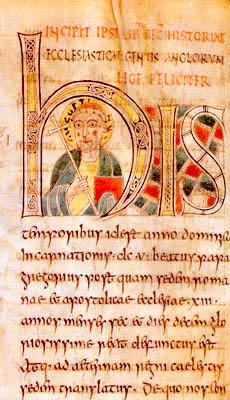
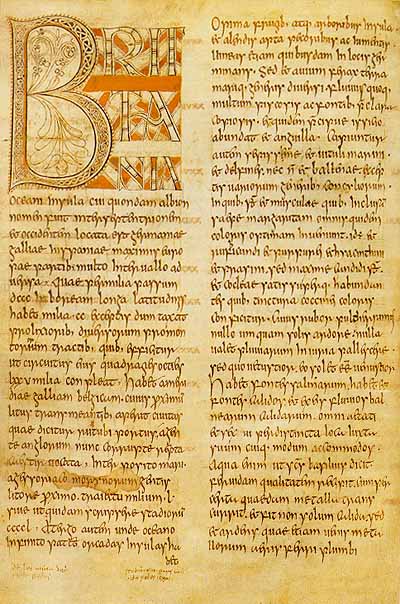 Since I am working an article on the symbols used to guide the reader to annotations in the margin and swiftly back again, I will not overdramatize the fact that some of these are missing from one of the oldest examples of Old English text we have. But I cannot help thinking about the practice of trimming manuscripts within our own context in the world of digital humanities, and this serves as an example of the type of information the Medieval Codes project endeavors to find in early English manuscript and print. The goal of digital texts is to transpose text from one medium (manuscript) to another (digital text and code). In this process, we have many usability and aesthetic choices to make. It’s true, we don’t trim pages, and we even ensure that they are photographed in their entirety, but we make concessions in other ways. Due to space constraints and load times, archival images are usually restricted to somewhere between 300 and 1000 dpi, depending on the size of the document. This is fine for one type of reading of the text, for accessing some forms of information, recognizing the words. On the other hand, looking at particular words, marks, and symbols or decoration, is not always easy. This is not to disparage archival practice, and it is not a plea for the necessity and primacy of the manuscript page, but a comment on the difficulty of reconciling usability, aesthetic choices, and financial considerations, with the importance of conserving archival material.
Many important aspects of a text are outside of the “linguistic dimension,” to use Jerome McGann’s terminology from The Textual Condition. Some of the “bibliographic codes” are encoded in the text’s organization and get lost when marginal content is disregarded or physically removed. There are tactile and extra-visual features of manuscript, social functions and psychological processes which are important to understanding manuscripts and printed books as well. While archival images and digital text encoded and displayed on a computer may not be able to capture all of the information in manuscripts, it is important that we study these extra-textual features.
Ben Neudorf
"we are mining a technology with a long history of human interaction for tools that our ancestors found effective for accessing information"This may bring up questions of how to digitally encode signes-de-renvoi, which are both idiosyncratic and based on convention, or whether a page turned or made into a tab for easy access can adequately translate to a link or bookmark in a digital text. More importantly, by paying attention to how medieval texts are organized, we are mining a technology with a long history of human interaction for tools that our ancestors found effective for accessing information, keeping in mind that speed and effectiveness are not necessarily related. Computers were built with calculation in mind, but books were created to facilitate human navigation of text. We have a lot to learn from books that can only enrich our digital experience with text. Part of the process is looking outside of the purely textual, and into the social, psychological, and bibliographical aspects of our navigation of books.
Ben Neudorf
Subscribe to:
Posts
(
Atom
)