Showing posts with label punctuation. Show all posts

Apr 17, 2015

Writing as encoding

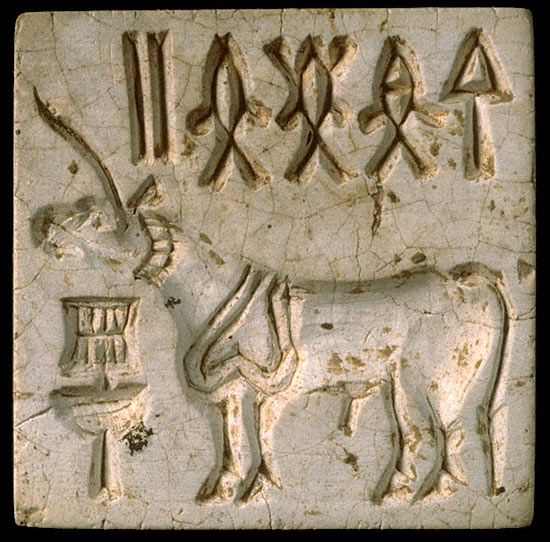
Unicorn seal from Harappa, c. 2200 BC. Image: Harappa.com.

This project explores the history of medieval information technology by modelling writing as code. But what, exactly, does writing encode? Answers to this question are complex, significant, and richly productive.
what does writing encode?

The easy answer is that writing encodes information. The earliest forms of writing seem to have been used for accounting. However, there is some debate among historians of writing over whether visual semiotic systems that encode non-linguistic information should be considered ‘writing’. This is perhaps a semantic quibble, but it underlines a very important historical development: at some point, every writing system commonly used today was adapted for linguistic information. Since the most commonly and frequently used method that humans use to create, store, transmit, and process information is verbal – that is, humanly usable information is mostly linguistic – this tight linkage of writing and language became overwhelmingly powerful. It is easy to think of writing only as a representation of language, and of spoken language in particular.

Aug 5, 2014

Asterisks in the Middle Ages

Astérix and Obélix. Image: the Indomitable Blog.
One of the jokes of René Goscinny and Albert Uderzo’s Astérix comics is that the names of the two main characters, Astérix and Obélix, are typographic puns: the asterisk and obelus (also obelisk, thus a double pun referring both to the punctuation mark and to the menhirs that Obélix carries around) were used since Aristarchus of Samothrace edited Homer in the 2nd century BC. The origins and early use of both punctuation marks are described in a chapter of Keith Houston’s cheerfully readable Shady Characters: The Secret Life of Punctuation, Symbols, and Other Typographical Marks (2013), practically the only reasonably informative book in English about the history of punctuation since Malcolm Parkes’s more scholarly Pause and Effect: An Introduction to the History of Punctuation in the West (1993). For more about the obelus (which became the modern typographic dagger), read Houston’s book. Here I will focus on the asterisk.

Oct 28, 2013

Punctuating Manuscripts


Have you ever considered what a text would look like without punctuation? In what way would an author ensure that they successfully conveyed the appropriate meaning to their audience and how would the audience identify meaningful units, or senses, within a text? Punctuation is, and always has been, a useful way of dividing text into smaller units of meaning, dispelling ambiguity and developing a specific meaning. In approaching text as a model of information it is important to consider not only how information was encoded but also how it was decoded – a process in which punctuation has been, and continues to be, a powerful tool.