Showing posts with label reading. Show all posts

Sep 17, 2021

Remote Reading

Yin Liu

A student examines the 15th-century Brendan Missal, University of Saskatchewan Special Collections, 2017.

The University of Saskatchewan dairy herd. Lots of cows, not much parchment. 
When COVID-19 restrictions made most of us in Canada stay at least 2 m away from each other, shut down international travel, and compelled many academics to work from domestic spaces frequently traversed by cats and children, manuscript scholars faced, in a heightened form, a paradox that we have been grappling with ever since digital technologies gave us access to manuscript images online. On the one hand, someone like me, who lives in the middle of Canada surrounded by a vast expanse of farmland and a vast absence of medieval manuscripts, has had my teaching and research practice revolutionised by the wonderful array of manuscript images freely available on the Web, thanks to the generosity of many holding institutions and their funding sources. On the other hand, any manuscript scholar knows that staring at an image on a screen is not the same as holding a manuscript in one’s hands. Digital technology opens up some ways of approaching medieval documents, at the cost of shutting down others.

Mar 25, 2015

Reading twitchily, then and now

A physician reading. Image: US National Library of Medicine.
[Right: Historiated initial from the Articella. Bethesda, United States National Library of Medicine, MS of the Articella, fol. 19v. Oxford, 13th century.]

After expressing all kinds of scepticism in two previous posts (here and here) about Paul Saenger’s arguments concerning word separation, I think it only fair to lay out an aspect of reading with spaces that, according to more recent studies on the neuropsychology of reading, Saenger got (mostly) right. It has been empirically demonstrated that word separation by space does speed up reading for skilled adult readers. Furthermore, it does so in a range of writing systems, including writing systems that use scriptio continua, that is, those that do not conventionally separate words by space, such as Chinese or Thai. In other words, even when skilled readers of such scripts are confronted with unconventionally word-separated text, they process the text more quickly.

Feb 20, 2015

Reading with spaces in Anglo-Saxon England

Boisil teaching Cuthbert. Image: British Library.
In the Life of St Cuthbert composed by Bede c 721, there is an episode in which Cuthbert asks his mentor, the saintly Boisil, to recommend a book that can be read in one week. Boisil suggests the Gospel of John, and provides a copy consisting of seven quires (codex habens quaterniones septem), which the two of them read together, one quire a day, until Boisil, as he has predicted, dies at the end of the seven days.

[Image: London, British Library MS Yates Thompson 26, fol. 21r, detail. Durham, late 12th century. Miniature from Bede's Vita Sancti Cuthberti.]

Whether or not this story can be entirely accepted as historical fact is perhaps doubtful; it occurs in a text that is concerned more with promoting the saintliness of Cuthbert than with what we might consider historical accuracy, and I suspect that Bede wants us to see a parallel between the seven days of reading, after which Boisil goes to his eternal rest, and the biblical seven days of creation, at the end of which God rested. As well, we might wonder at Boisil’s recommendation of the Gospel of John as a book it would take a week to read; in a modern English translation this text is about the length of a longish short story, and a skilled modern reader could easily read through it in an hour or two. Each quire (quaternion) in Boisil’s manuscript would be the equivalent of 16 pages, but Boisil expected Cuthbert to take a day to read each quire. What is even more striking is that Bede considers a week’s time to be a quick read of the Gospel of John; he implies that ordinarily it would have taken longer. Medieval people must have been slow readers.

Well, yes, by evidence such as this, medieval people were slow readers by our standards. But to discover why, we have to consider the evidence more carefully.

Jun 30, 2014

Users and readers

Johannes Sambucus, Emblemata (1564), p. 62. Image: Glasgow University Library.
The language we use to describe how we interact with various forms of information technology betrays the distinctions we make between these forms. To a print publisher, I am a reader; to a software company, I am a user. That is, we read books, but we use digital devices. This distinction, however, depends both on a very narrow sense of read and a somewhat artificial distinction between reading and use, and should be challenged.

Jan 29, 2014

Things that talk

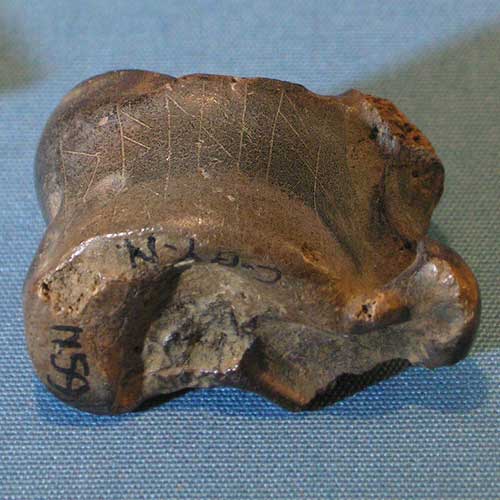
The Caistor-by-Norwich astragalus. Image: Christer Hamp.
This object is an astragalus, the ankle-bone of a roe deer. It was probably used as a game piece and was placed, along with a number of other such pieces, in a 5th-century cremation urn buried in an Anglo-Saxon cemetery at Caistor-by-Norwich, Norfolk. On it is scratched six runes which can be transliterated (roughly, because of font limitations) raihan. Thus this unattractive little object preserves what is probably the earliest known record of writing in England.

Dec 5, 2013

Interactive medieval media

Interactive is a positive buzzword in the digital world today; the Oxford English Dictionary records it as being applied from the 1960s onward to computing devices that respond to user input. When used of digital media or devices, interactive carries positive connotations because it stands against passive: instead of presupposing a one-way flow of information from a smart device to a stupid user (a model that supports the familiar technology-makes-you-stupid topos), interactivity is engaging, stimulating, perhaps even enhances intellectual ability. Leaving aside, for now, the question of whether interactivity is desirable, we might recognise three ways in which medieval textual interfaces can be said to be interactive.

Brendan Missal, University of Saskatchewan Special Collections

Nov 6, 2013

Models for Text

The paper I gave in New York recently, at an INKE conference, tentatively explored the idea that multiple models for text are desirable because humans use text in various ways. The four models for text I proposed, by way of example, are summarised in this table:


Oct 28, 2013

Punctuating Manuscripts


Have you ever considered what a text would look like without punctuation? In what way would an author ensure that they successfully conveyed the appropriate meaning to their audience and how would the audience identify meaningful units, or senses, within a text? Punctuation is, and always has been, a useful way of dividing text into smaller units of meaning, dispelling ambiguity and developing a specific meaning. In approaching text as a model of information it is important to consider not only how information was encoded but also how it was decoded – a process in which punctuation has been, and continues to be, a powerful tool.

Aug 23, 2013

Not reading the St Cuthbert Gospel

In 2012, after a huge fundraising campaign, the British Library acquired the St Cuthbert Gospel, formerly known as the Stonyhurst Gospel, the oldest complete European book to survive intact in its original binding.
British Library MS Additional 89000, fol. 1r.
The St Cuthbert Gospel. Image: British Library.

Jul 19, 2013

A note on religious engagement with texts


At the Social, Digital, Scholarly Editing conference at the University of Saskatchewan, Paul Eggert began by saying an edition is a transaction between the editor and the reader.  Wendy Phillips-Rodriguez's talk entitled “Social, Digital, Codicological Editing?” discussed how sometimes that transaction can involve the highly specific needs of a group of readers.  The Digital Shikshapatri is an edition of an Indian religious text, and is accessed at the Bodleian Library most often by people who use the text to aid in worship. To accommodate this type of reader, the digital edition has some unique features: readings of the text by Yogi Charan Das, and audio files to accompany each page.  It was also mentioned that this method of display acknowledges the belief that the spoken word realizes the true power of language in a way that text does not.

This type of engagement with text is a common context for medieval manuscripts, and some designs show a great amount of care for the reader experience.  Daniel Connolly discusses the itinerary to Jerusalem in Matthew Paris’ Chronica Majora, which is a large mapped sequence, as an "Imagined Pilgrimage" for clerical readers who were unable to leave their monastery due to religious vows they had taken.  The Chronica Majora uses sophisticated indexing techniques to take the reader quickly from the written text to illustrations of various cities and scenes in the margins, which often take up most of the page.  The sign “φ” is used, and when the connected text or image is oriented sideways, the sign is also rotated to give a visual cue for the reader, suggesting the proper orientation.  Other times, the paraph mark is repeated beside an image, suggesting that an image corresponds to each section of text.  These indexing structures support a quick transition between text and visual content that helps maintain an immersive imagined experience.

 When I first came across the Chronica Majora, I couldn’t help thinking about another imagined pilgrimage I had recently come across, the video game Journey by thatgamecompany. It’s one of the most beautiful games I’ve played, with an amazing soundtrack and not a word of written or spoken text.  In this virtual Hajj, a succession of trials brings the character closer to the mountain’s peak.  Though the game is likely not intended primarily for a religious audience, the experience is highly meditative and serene.  I won’t force this comparison, but I would like to suggest that this type of religious engagement and imagined or virtual experience can be an important part of the creation of text designed to facilitate meaningful interactions with the reader.

Ben Neudorf

Connolly, Daniel K. “Imagined Pilgrimage in the Itinerary Maps of Matthew Paris.” The Art Bulletin 81.4 (1999): 598–622.

Matthew Paris, Chronica majora, ca. 1250, vol. 1, Parker Library, Corpus Christi College, Cambridge, MS 26.

Phillips-Rodriguez, Wendy. "Social, Digital, Codicological Editing?" SDSE Conference. U of Saskatchewan. 11 July 2013. Address.