Jun 18, 2015

25 best from the Luttrell Psalter

Thanks for waiting, and here it is: another compilation of weird medieval manuscript images from Medieval Codes researcher Courtney Tuck.

The Luttrell Psalter (London, British Library MS Additional 42130) was created for Sir Geoffrey Luttrell, the lord of Irnham in Lincolnshire, England. It has been dated to 1276-1345 and it is currently housed in the British Library, which has digitized it for online access. Sir Geoffrey and his family are depicted within the Psalter’s pages, as well as scenes of daily life. Those, however, are only some of the intriguing and entertaining marginal illustrations found in the Luttrell Psalter.  As I had previously created a top ten most memorable marginal illuminations from the Macclesfield Psalter for an earlier blog post, I attempted to do the same for the Luttrell.  This, however, would not be as easy a task due to the large amount of memorable illustrations. The first list I attempted to compile had over 70 images in it. While all were interesting, I thought perhaps that would be too much. I persevered and was able to narrow it down to 25 of the most memorable images. As I was working through this manuscript I was actually able to use the images as mnemonic devices in case I lost my place, which was one of their original functions. There was one word that I kept using to describe these images: wacky! Many animal-human hybrids as well as invented creatures get up to hi-jinks and even interact with humans within the margins. Let us take a look at these top 25 most memorable images from the Luttrell Psalter, as well as how they have been perceived by my modern mind.
 
25 - This horse/human/bat hybrid is standing in a saucy contrapposto position. We could all take a lesson in such confidence and effortless style.  Work it, you feisty creature, you!


Jun 3, 2015

The International Medieval Congress in Kalamazoo - A Review

Kalamazoo in May (detail). Image: Yin Liu, 2013.
The International Medieval Congress held annually in Kalamazoo, Michigan is well-known by all of its regular attendees for being a unique combination of rigorous scholarship, expertise, and answer-seeking tainted with ribaldry, camaraderie, and an incorrigible excitement for books and imbibing. This year, May 2015, marked the 50th anniversary since the congress’ inception. I was fortunate enough to attend, playing the part of an envoy on behalf of the Medieval Codes project from the University of Saskatchewan. Approximately 3,000 medieval scholars gather at the congress which itself features more than 550 sessions of papers, panel discussions, round tables, workshops, and performances. Evening meetings and receptions are sponsored by academic institutions and societies. Nearly 70 exhibitors, including publishers, used book dealers, as well as artists and craftsmen fill the exhibits hall with their wares.

Apr 17, 2015

Writing as encoding

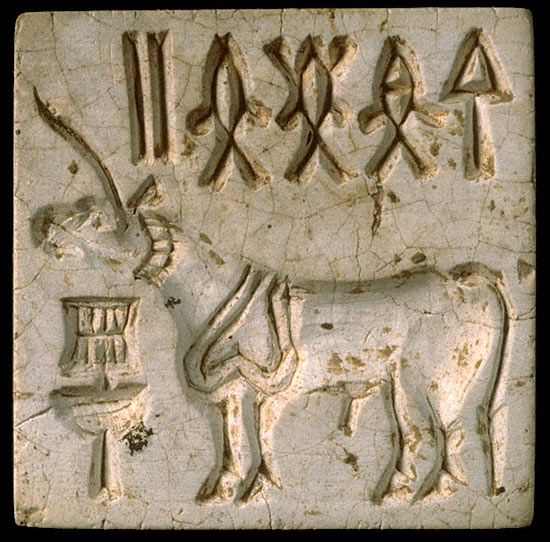
Unicorn seal from Harappa, c. 2200 BC. Image: Harappa.com.

This project explores the history of medieval information technology by modelling writing as code. But what, exactly, does writing encode? Answers to this question are complex, significant, and richly productive.
what does writing encode?

The easy answer is that writing encodes information. The earliest forms of writing seem to have been used for accounting. However, there is some debate among historians of writing over whether visual semiotic systems that encode non-linguistic information should be considered ‘writing’. This is perhaps a semantic quibble, but it underlines a very important historical development: at some point, every writing system commonly used today was adapted for linguistic information. Since the most commonly and frequently used method that humans use to create, store, transmit, and process information is verbal – that is, humanly usable information is mostly linguistic – this tight linkage of writing and language became overwhelmingly powerful. It is easy to think of writing only as a representation of language, and of spoken language in particular.

Apr 6, 2015

The marvels of Hesdin

Now that April 1 is well past, it’s probably safe to try this little diversion about something weird and wacky from the Middle Ages: the entertainment mechanisms of Hesdin Castle.

Image: Rob Zeldenrust.
[Image, left: detail of Wedding Party at the Park of Hesdin, 16th-century copy of a lost original possibly by Jan van Eyck.]

Hesdin was built by Count Robert II of Artois (1250-1302). It was, sadly, demolished in the 16th century. Our fullest account of the contraptions installed in the castle and its park comes from the accounts of the dukes of Burgundy, who spent a greal deal of money on the renovation and upkeep of Hesdin. In particular, an entry from the accounts of 1432 describes in detail the mechanisms on which Duke Philip the Good of Burgundy spent 1,000 livres to renovate or install, paid out to valet-de-chambre and painter Colard le Voleur:

Mar 25, 2015

Reading twitchily, then and now

A physician reading. Image: US National Library of Medicine.
[Right: Historiated initial from the Articella. Bethesda, United States National Library of Medicine, MS of the Articella, fol. 19v. Oxford, 13th century.]

After expressing all kinds of scepticism in two previous posts (here and here) about Paul Saenger’s arguments concerning word separation, I think it only fair to lay out an aspect of reading with spaces that, according to more recent studies on the neuropsychology of reading, Saenger got (mostly) right. It has been empirically demonstrated that word separation by space does speed up reading for skilled adult readers. Furthermore, it does so in a range of writing systems, including writing systems that use scriptio continua, that is, those that do not conventionally separate words by space, such as Chinese or Thai. In other words, even when skilled readers of such scripts are confronted with unconventionally word-separated text, they process the text more quickly.