 |
| Image: © Marie-Lan Nguyen / Wikimedia Commons / |
Apr 14, 2014
Calculation to communication

Mar 28, 2014
Not dead yet
| London, British Library MS 89074. Image: British Library.
89074
89074
|
I’d say yes; it’s a fifteenth-century English-Latin glossary, the Catholicon Anglicum, in its original binding. It's handwritten rather than printed, but I think most people would call this a book.
On New Year’s Day, 2014, Robert Bolick reflected intelligently and thoughtfully on the recurring meme of ‘the death of the book’ in this blog post. Since the early 1990s, various people, mostly journalists, have been loudly proclaiming ‘the death of reading’, ‘the death of the book’, ‘the end of books’. In 1991, the murderer was television. More recently, it’s the e-reader. Cautionary voices have responded by noting that it is too early to pronounce the epitaph for books, that new media have not killed reading, and that something that continually needs to be thumped on the head and declared dead is, on the contrary, probably not dead yet.
Feb 20, 2014
Latin in the margins
In a previous post, ‘Starting in the margins’, I noted that early examples of English writing were typically not standalone texts; rather, they tended to be glosses to Latin texts. In such bilingual documents from early medieval England, the Latin text was given prominence visually – the script was larger and it filled the main text block – while the English gloss, squeezed in between the lines in a smaller script or placed in the margins, was clearly meant to be apparatus in a supporting role.
Although this relationship of Latin and English continued to be expressed in similar ways in documents throughout the Middle Ages, there are also many cases in which the two languages appear to switch positions: English as the main text, Latin in the margins.
 |
| British Library MS Cotton Nero D.iv (Lindisfarne Gospels), fol. 45r. |
Although this relationship of Latin and English continued to be expressed in similar ways in documents throughout the Middle Ages, there are also many cases in which the two languages appear to switch positions: English as the main text, Latin in the margins.
 |
| Cambridge, Corpus Christi College MS 12, fol. 10r (detail) |
Jan 29, 2014
Things that talk
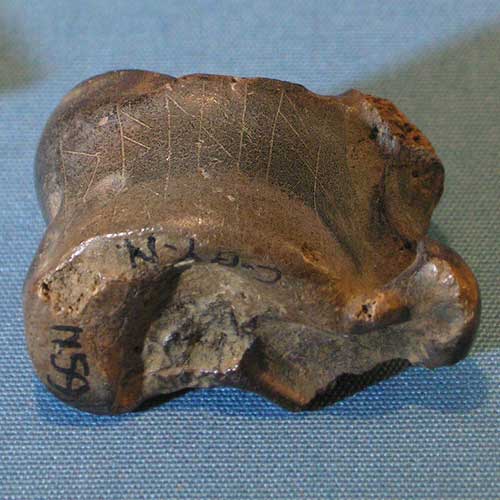 |
| The Caistor-by-Norwich astragalus. Image: Christer Hamp. |
Jan 17, 2014
Security Issues
 |
| Image: The Hague, Koninklijke Bibliotheek MS 132.F.21, fol. 555r (detail) |
Subscribe to:
Posts
(
Atom
)