Mar 7, 2015

10 best from the Macclesfield Psalter

And now a post from Medieval Codes team member Courtney Tuck:

The Macclesfield Psalter is a manuscript with very unusual marginal illustration. The manuscript was created around 1330 in the region of East Anglia, Britain. It is currently housed in the Fitzwilliam Museum in Cambridge. The absurdity, grotesques, anthropomorphized animals and scatological humour in this manuscript’s marginalia are all as surprising as they are enjoyable. It is an interesting look at what was funny and amusing to the medieval reader of this region. The role of marginal illustration has been identified by scholars as being a mnemonic device, which was especially helpful before pagination was developed. Odd and memorable images, often having nothing to do with the actual text on the page, help one differentiate and remember the location of pages and passages.

For your enjoyment, I have compiled my personal top 10 most memorable marginal illustrations from the Macclesfield Psalter. Some of the more rude images were left out of the list, though they are still worth finding and giggling to oneself over….

10 – This owl has no idea what’s about to hit him. Or perhaps he does….? This scene seems almost cartoonish. The owl’s expression reminds me of a Warner Brothers cartoon. That moment when Wiley E. Coyote has gone off the cliff, but not fallen, he looks at the audience and gives a knowing look or perhaps a small wave before he falls. Poor owl!

Feb 20, 2015

Reading with spaces in Anglo-Saxon England

Boisil teaching Cuthbert. Image: British Library.
In the Life of St Cuthbert composed by Bede c 721, there is an episode in which Cuthbert asks his mentor, the saintly Boisil, to recommend a book that can be read in one week. Boisil suggests the Gospel of John, and provides a copy consisting of seven quires (codex habens quaterniones septem), which the two of them read together, one quire a day, until Boisil, as he has predicted, dies at the end of the seven days.

[Image: London, British Library MS Yates Thompson 26, fol. 21r, detail. Durham, late 12th century. Miniature from Bede's Vita Sancti Cuthberti.]

Whether or not this story can be entirely accepted as historical fact is perhaps doubtful; it occurs in a text that is concerned more with promoting the saintliness of Cuthbert than with what we might consider historical accuracy, and I suspect that Bede wants us to see a parallel between the seven days of reading, after which Boisil goes to his eternal rest, and the biblical seven days of creation, at the end of which God rested. As well, we might wonder at Boisil’s recommendation of the Gospel of John as a book it would take a week to read; in a modern English translation this text is about the length of a longish short story, and a skilled modern reader could easily read through it in an hour or two. Each quire (quaternion) in Boisil’s manuscript would be the equivalent of 16 pages, but Boisil expected Cuthbert to take a day to read each quire. What is even more striking is that Bede considers a week’s time to be a quick read of the Gospel of John; he implies that ordinarily it would have taken longer. Medieval people must have been slow readers.

Well, yes, by evidence such as this, medieval people were slow readers by our standards. But to discover why, we have to consider the evidence more carefully.

Feb 11, 2015

Spaces and silence

 London, British Library MS Harley 1775 (Harley Gospels), fol. 373v. John 1.14 per cola et commata, in scriptio continua.

In 1997, Paul Saenger pulled off a feat I admire: he published a lengthy, detailed, and learned book entirely about the little spaces between words. Space Between Words is still the place to go for a painstaking account of the history of word separation in the medieval West, from the first texts separated by space in late 7th-century Ireland to the eventual adoption of canonical word separation for all Latin and vernacular texts in western Europe by the end of the Middle Ages. Although early Greek and Roman texts separated words by interpuncts (little dots), later Latin texts were written in scriptio continua (or scriptura continua): a continuous string of characters without spaces to mark word boundaries. Beginning in the late 7th century, Irish scribes introduced spaces at irregular intervals to create what Saenger calls ‘aerated’ text , and, by the 11th century, scribes in northern Europe were separating Latin text ‘canonically’ – that is, the way we do now in standard written English, with spaces between words. This history can be verified by checking the manuscripts that Saenger cites as examples, if anyone has the gumption to follow up all the items in Saenger’s impressive nineteen-page list. I, for one, am quite happy to take Saenger’s word for it.

London, British Library MS Additional 89000 (St Cuthbert Gospel), fol. 1v. John 1.14 with canonical word separation.

More controversial, however, is the argument that Saenger builds on top of this history, an argument encapsulated in the subtitle of the book: The Origins of Silent Reading. Briefly, Saenger claims that word separation was, in the Middle Ages, ‘the crucial element in the change to silent reading’. Silent reading, in turn, facilitated ‘reference reading’ – the technique of scanning texts quickly to find specific items of information – and contributed to the shift from the idea of reading as a public activity, as it was in the ancient world, to the idea of reading as a private activity, as it is in the modern world. I am, of course, greatly oversimplifying Saenger’s ideas here, but if you want all the details, you should read the book.

Saenger’s thesis may be attractive, not least the argument that a seemingly innocuous and subtle encoding practice – introducing a bit of white space between words in written texts – has had such far-reaching technological and social effects. But is there a straightforward causal relationship between word separation and silent reading? I’m not so sure.

Jan 23, 2015

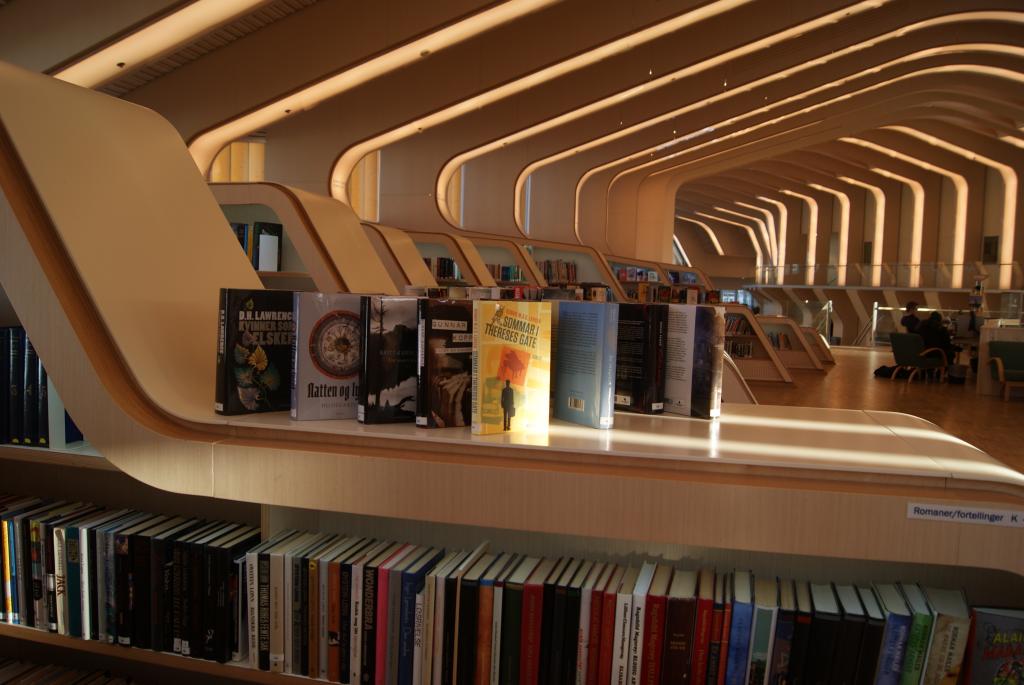
Information architecture: Texts as buildings

Vennesla Library, Norway. Image: NAPLE library buildings database.
The concept of information architecture is not new, although the modern use of the term, and the profession associated with it, dates from the 1970s. It is most often applied today to website design; the Oxford English Dictionary defines it as a computing term: ‘the manner in which information is stored, organized, or disseminated, (now) esp. online or on a web site’  (s.v. information, C2, information architecture).

Information architecture is, of course, a metaphor; one does not build websites in the same way in which one constructs buildings. In this case, the metaphor is a model: it suggests certain ways of thinking about the abstraction that we call ‘information’. The modern phrase was coined to convey the idea that, just as buildings are designed for storage, movement, and functionality, so analogous design principles apply to the ways we might store, navigate, and use information.

Jan 9, 2015

Don't blame the Vikings

Ruins of Lindisfarne Priory. Image: English Heritage.
In the year 793, Vikings raided the monastic community at Lindisfarne, in the Northumbrian kingdom of Bernicia. It was the ominous beginning to a series of assaults on England; the following year, Vikings pillaged the monastery at Jarrow. It is unlikely that the Vikings were making deliberate attacks on Anglo-Saxon scholarship by targeting these places of learning; monasteries were known to be full of valuable objects, and monks were probably not expected to be formidable opponents. The raiders were interested in loot and, later, in land; over the next hundred years, the once-powerful Anglo-Saxon kingdoms of Northumbria, East Anglia, and Mercia crumbled before increasingly extensive Viking incursions. The Scandinavian takeover of England was not significantly halted until the West Saxon king Alfred, driven into a hideout in the marshes of Somerset, somehow managed to organise the remnants of the local Anglo-Saxon militia and to defeat the Danish forces at the battle of Edington in 878.