Showing posts with label design. Show all posts

Apr 24, 2018

The Construction and Function of a Physician’s Folding Almanac: British Library Harley MS 937

Julie Maseka

Leather case of Harley MS 937
Harley MS 937 is plainly catalogued by the British Library as a physician's folding almanac; however, this description fails to capture the uniqueness of this seemingly simple, yet intriguing, manuscript. In general, folded almanacs contain “calendrical, astrological, and medical elements” thought to have been used by both medical practitioners and laypeople (Carey, "What is the Folded Almanac?" 482). Harley MS 937 stands out in this category of manuscripts due to its distinct construction and interesting textual content. The manuscript is folded and enclosed in a leather pouch bound with a braided string, which offers both protection and portability. The text is in English vernacular, although Latin would be commonly expected of astrological-medical documents of this time period. While the text poses questions about the owner(s) of the manuscript and how they may have practically used it, this post will focus on how the physical format of Harley MS 937 influences its transportability and readability, leaving the discussion of the intended owner and the manuscript's application in medieval daily life for a later date.

Mar 7, 2017

Troy Book Comparisons

The last of Hailey Mullock's series on decoration in manuscripts of Lydgate's Troy Book.

Cambridge, Trinity College MS O.5.2, fol. 38r
The Hierarchy of Decoration within the Troy Book text in British Library MS Royal 18 D II appears to be integral to the text. In order to determine how integral the decoration was to the text or if it was integral at all, I compared Royal 18 D II to other manuscripts that contain the Troy Book text. There are currently twenty-three manuscripts that contain John Lydgate’s Troy Book, eight of which are illustrated, “and a basic visual program can be detected in each of them” (Whitehead v). Of those twenty-three, only three digital facsimiles are available on the Web at this time: of British Library MS Royal 18 D II; Cambridge, Trinity College, MS O.5.2; and Cambridge, Massachusetts, Houghton Library, Harvard University MS Eng 752.

In examining these three manuscripts, it appears that the hierarchy of decoration is not consistent or integral to this particular text, as the manuscripts vary in decoration. However, further research into the inaccessible manuscripts shows that most of the time the manuscripts containing the Troy Book text have a hierarchy of decoration similar to both Royal 18 D II and Trinity O.5.2. The majority of the manuscripts contain similar decoration at the beginning of each book and the decorations are all in the same order of the hierarchy in each manuscript. The beginnings of the books are marked by an illustration, border decoration, and a large display initial following the illustration. What is even more interesting is that although the illustrations are not always identical, the subject and placement of the illustrations are the same for the majority of the manuscripts. It is possible that there was a presentation copy, an exemplar, from which all of the illustrations were copied.

Dec 29, 2016

Following Lydgate: Troy Book to Siege of Thebes

Here is another post by Medieval Codes researcher Hailey Mullock on decoration in a Lydgate manuscript.

London, British Library MS Royal 18 D II, fol. 147v.
Medieval manuscripts are often miscellanies of several works. British Library MS Royal 18 D II contains several works along with John Lydgate’s Troy Book. Lydgate’s Siege of Thebes, also included in Royal 18 D II, is the complement to Troy Book. Siege of Thebes was written to be the last tale of Chaucer’s Canterbury Tales, with Lydgate himself inserted as a pilgrim on the Canterbury pilgrimage. Unlike Troy Book, Siege of Thebes was not written for a patron, but was still a very popular and widely circulated text. It was a continued presence in English Renaissance literature because of John Stow’s 1561 edition of The Workes of Geffrey Chaucer. Stow included Lydgate’s poem among his ‘divers addicions’ to Chaucer. Lydgate’s work as the last tale of the Canterbury Tales balances out the Knight’s Tale by providing the story of the siege of Thebes, ending where the Knight’s Tale begins.

Oct 24, 2016

Hierarchy of Decoration

London, British Library MS Royal 18 D II, fol. 6r, top margin

A post from Medieval Codes researcher Hailey Mullock.
 
Many medieval manuscripts contain elements of decoration, from single-coloured capital letters to fully illuminated pages with illustrations and elaborate borders. The decoration was not only for visual appeal but also worked to organize the text and convey information. Medieval manuscripts were often written in black with few page breaks or divisions, and decoration helped to divide and highlight aspects of a text. In order for the decorations to convey information to the reader, each manuscript, and sometimes text, has its own hierarchy of decoration. The decorative elements often change in size and colour depending on their position and function.

Jan 23, 2015

Information architecture: Texts as buildings

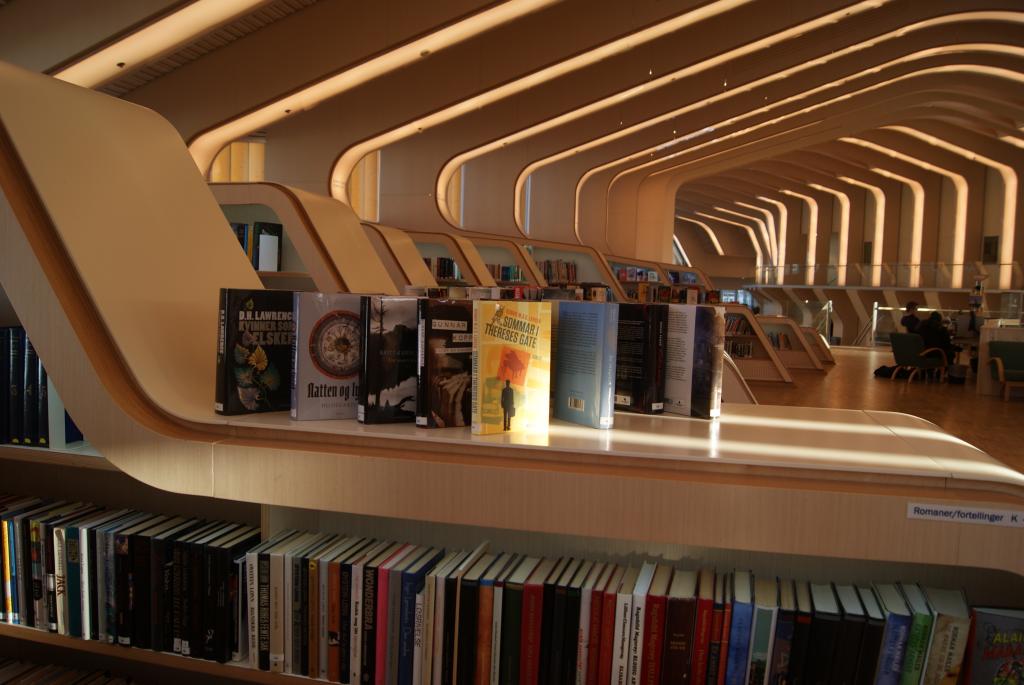
Vennesla Library, Norway. Image: NAPLE library buildings database.
The concept of information architecture is not new, although the modern use of the term, and the profession associated with it, dates from the 1970s. It is most often applied today to website design; the Oxford English Dictionary defines it as a computing term: ‘the manner in which information is stored, organized, or disseminated, (now) esp. online or on a web site’  (s.v. information, C2, information architecture).

Information architecture is, of course, a metaphor; one does not build websites in the same way in which one constructs buildings. In this case, the metaphor is a model: it suggests certain ways of thinking about the abstraction that we call ‘information’. The modern phrase was coined to convey the idea that, just as buildings are designed for storage, movement, and functionality, so analogous design principles apply to the ways we might store, navigate, and use information.

Sep 13, 2014

User-friendly devices and device-friendly users


This 2000 sketch from the Norwegian television program Øystein og jeg has been a classic since it was posted on YouTube. One reason we (including medievalists) like it is, probably, that it reminds us that information and communication technologies we take for granted today – such as the codex – were once ‘new media’. In other words, reading a book is not learned naturally, like learning language; people have to be trained to use technology.