Jan 23, 2015

Information architecture: Texts as buildings

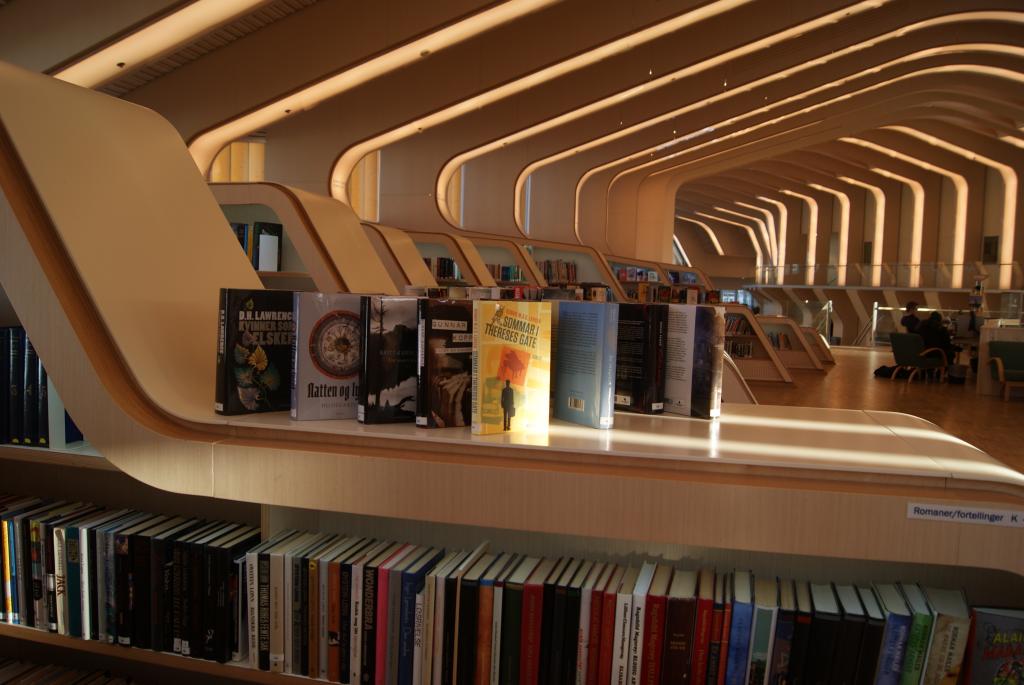
Vennesla Library, Norway. Image: NAPLE library buildings database.
The concept of information architecture is not new, although the modern use of the term, and the profession associated with it, dates from the 1970s. It is most often applied today to website design; the Oxford English Dictionary defines it as a computing term: ‘the manner in which information is stored, organized, or disseminated, (now) esp. online or on a web site’  (s.v. information, C2, information architecture).

Information architecture is, of course, a metaphor; one does not build websites in the same way in which one constructs buildings. In this case, the metaphor is a model: it suggests certain ways of thinking about the abstraction that we call ‘information’. The modern phrase was coined to convey the idea that, just as buildings are designed for storage, movement, and functionality, so analogous design principles apply to the ways we might store, navigate, and use information.

Jan 9, 2015

Don't blame the Vikings

Ruins of Lindisfarne Priory. Image: English Heritage.
In the year 793, Vikings raided the monastic community at Lindisfarne, in the Northumbrian kingdom of Bernicia. It was the ominous beginning to a series of assaults on England; the following year, Vikings pillaged the monastery at Jarrow. It is unlikely that the Vikings were making deliberate attacks on Anglo-Saxon scholarship by targeting these places of learning; monasteries were known to be full of valuable objects, and monks were probably not expected to be formidable opponents. The raiders were interested in loot and, later, in land; over the next hundred years, the once-powerful Anglo-Saxon kingdoms of Northumbria, East Anglia, and Mercia crumbled before increasingly extensive Viking incursions. The Scandinavian takeover of England was not significantly halted until the West Saxon king Alfred, driven into a hideout in the marshes of Somerset, somehow managed to organise the remnants of the local Anglo-Saxon militia and to defeat the Danish forces at the battle of Edington in 878.

Dec 18, 2014

Merry Christmas 2014

London, British Library MS Additional 18850, fol. 65r. Image: British Library.

Well, it's time for our annual Christmas post, and since some of us have been enjoying the art in the Bedford Hours, here's a Nativity scene from that manuscript: London, British Library MS Additional 18850, fol. 65r. (Click on the image to go to the British Library digital facsimile, where you can zoom in for more detail.) There's a little bit of text (Latin in the centre, and at the bottom two lines in French), but it's hard to escape the feeling that you're not really meant to read this page, but to look at it. The main picture shows Joseph and Mary adoring the Christ Child, who seems to have been moved out of the manger to the right and placed in a canopied bed that is surely quite incongruous for a stable -- not to mention the embroidered cushion on which Mary is kneeling, or the fine mantle she is wearing. Joseph, by contrast, is more plainly clad, although the accessory on his right arm shows either that a medieval man could carry a purse and get away with it, or that husbands have been stuck awkwardly holding their wives' purses since at least the early fifteenth century. We also have an obligatory pair of farm animals (the ox and ass of tradition) in the foreground. Looking over the fence are some spectators, probably the shepherds, and behind them a winter scene, complete with a deer cavorting through the leafless trees and a bear rambling through the snow, while God the Father shines down benevolently on all.

Around the main picture are an elaborate decorated border and some smaller pictures of scenes from the Christmas story: for example, that's probably another shepherd in the top left corner, while the two corner scenes below hint ominously at the Massacre of the Innocents. And if you can figure out why there are rabbits at the bottom of the page, and what they are doing, and what possible relevance they have to anything else, you probably deserve a prize, or you're overthinking it. Go eat a large roasted bird. Merry Christmas from fifteenth-century England.

Yin Liu
Dec 8, 2014

Heraldry as code

London, British Library MS Harley 3479 (the Harley Froissart), fol. 83v, detail. Image: British Library.

This miniature from the Harley Froissart, a sumptious manuscript made c 1470-1472 in Bruges, shows European forces attacking a walled town in North Africa: la forte ville dauffrique en barbarie, says the rubricated caption, ‘the strong town of Affricque in Barbary’. Among the many items of interest in this image are the flags carried by the attackers, camped out around the town. The artist has taken care to depict the arms of various European leaders on these flags: easily recognisable, for example, are the royal arms of France, azure, three fleur-de-lys or, on the third square flag from the left. Although this project deals mostly with medieval textual codes – what we usually think of as ‘writing’ – medieval Europe also had another highly developed non-linguistic semiotic code, that of heraldry, which often intersected with the world of books.

Nov 19, 2014

Information retrieval strategies

London, British Library MS Royal 13.E.vi, fol. 1v. Image: British Library.
The image here is a table of signa, indexing symbols invented by Ralph of Diceto in the 1100s for his historical works, the Abbreviationes chronicorum and Imagines historiarum. They enable the reader to search for points in the text that deal with various topics or historical persons, such as kings of England and dukes of Normandy (a crown next to a sword), or conflicts within the royal family (two hands pulling a crown in different directions).

Information retrieval is one of the major industries of our digital world. It is both an academic field of study and a set of technologies and techniques. We often think of it, therefore, as something that we do with machines, or that machines do for us. If I want to find, say, a definition of ‘information retrieval’, I type the term into everyone’s favourite search engine and discover that the first hit is (no surprise) a Wikipedia article, followed by a couple of online textbooks and a link to an academic journal devoted to the subject. Here’s how one of the textbooks (Manning, Raghavan, and Schütze 2008) defines information retrieval:

    Information retrieval (IR) is finding material (usually documents) of an unstructured nature (usually text) that satisfies an information need from within large collections (usually stored on computers).

three main strategies for finding a particular item of textual information
I like the repetition of ‘usually’ in that definition because it reminds us that although we usually think of information retrieval as a computing activity, searching for stuff on Google is only one form – and generally not the most effective – of information retrieval.

How did information retrieval work in the Middle Ages? We can posit three main strategies for finding a particular item of textual information.